
Across the Permian Basin, hundreds of oil and gas well pads are awaiting reclamation, creating a growing need for restoration practices that work in the region’s challenging environment. A multi-year research partnership between the Borderlands Research Institute (BRI) at Sul Ross State University and Apache Corporation is providing new information to help identify practical, effective approaches for restoring well pads as they reach the end of their operational life.
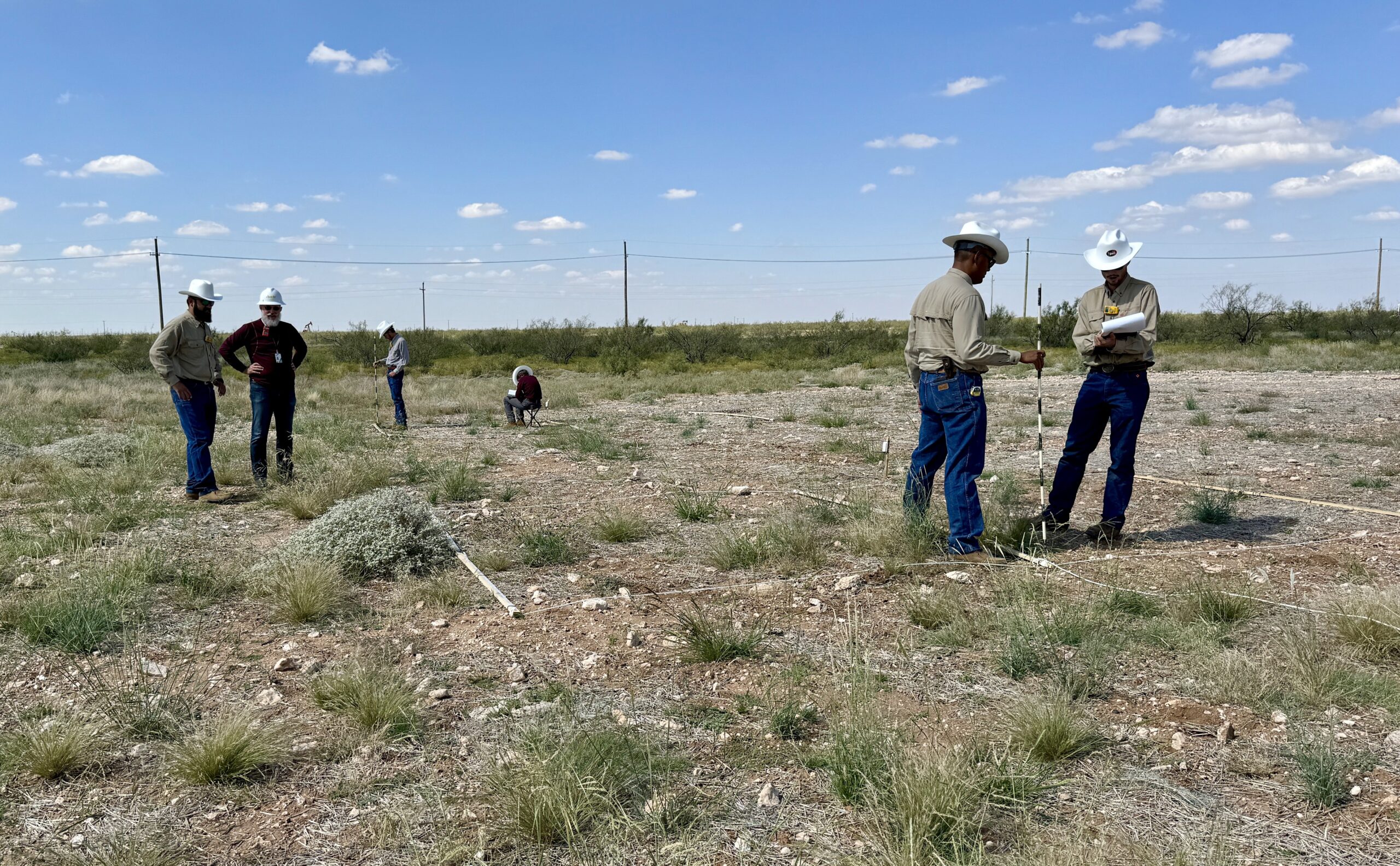
Beginning in 2024, BRI researchers tested eight reclamation treatments on 25 retired oil and gas well pads operated by Apache in Midland County. The goal was to find practical ways to help native vegetation get established in a landscape where limited and unpredictable rainfall makes restoration especially challenging.
“This project demonstrates the value of collaboration between industry and academia in advancing environmental stewardship,” said Travis Ethredge, director of Environment, Health and Safety for Apache. “Through our partnership with Sul Ross State University, we’ve gained valuable insights into reclamation practices that can help improve land restoration efforts and support responsible stewardship of the areas where we operate.”
All 25 sites were seeded with the same native seed mixture. Researchers then tested several approaches to see what might help those seeds get established. Some plots received organic matter or biochar, a soil amendment used to improve soil properties and nutrient retention. Other plots were treated with Hydretain and covered with soil erosion blankets to help conserve moisture.
After two growing seasons, water retention emerged as the key to getting more vegetation established.
The four water-retention treatments averaged 41.6 percent vegetation cover by the end of the 2025 growing season, compared with 14.6 percent for seeding alone. Soil monitoring helped explain the difference. After a rain, the water-retention treatments stayed wetter longer, with wet periods lasting about 70 percent longer than treatments without water retention.
“It’s no surprise that water is critical to restoring vegetation in a desert environment,” said Dr. Carlos “Lalo” Gonzalez, Nau Endowed Chair in Habitat Research and Management at BRI and SRSU. “We wanted to know what we could do to keep the little rain we get in the soil a little longer. That extra time can make a real difference when you’re trying to get native plants started.”
Researchers also found that piling on additional treatments didn’t necessarily improve the outcome. Native seed, Hydretain and a soil erosion blanket resulted in 40 percent vegetation cover. Researchers documented 30 native plant species in that treatment in 2025, the highest number among the treatments tested. Adding organic matter or biochar did not consistently boost vegetation cover or the number of native species.
Cost is also an important consideration when determining whether restoration practices can be applied at larger scales. The more intensive treatment produced slightly greater vegetation cover. But they required substantially more material and labor than the simpler water retention treatment. These results suggest that relatively simple approaches focused on retaining soil moisture may provide a more practical outcome between restoration performance and cost. This is particularly important when reclamation must be implemented across large areas.
“If you’re a land manager, cost matters,” Gonzalez said. “The most expensive option didn’t give us a dramatically different result. That’s useful to know when you’re deciding how to invest restoration dollars.”
The project was large enough to test whether those results held up from one site to another. All eight treatments were replicated across the 25 well pads.
“That was one of the real strengths of working with Apache,” Gonzalez said. “We weren’t testing this on one small plot. We were able to work across 25 sites and see how these treatments performed on the ground. The project was a great success, and we came away with practical information we can use to improve future reclamation work.”
Photo: BRI students gather data on retired oil and gas well pads in Midland County.