
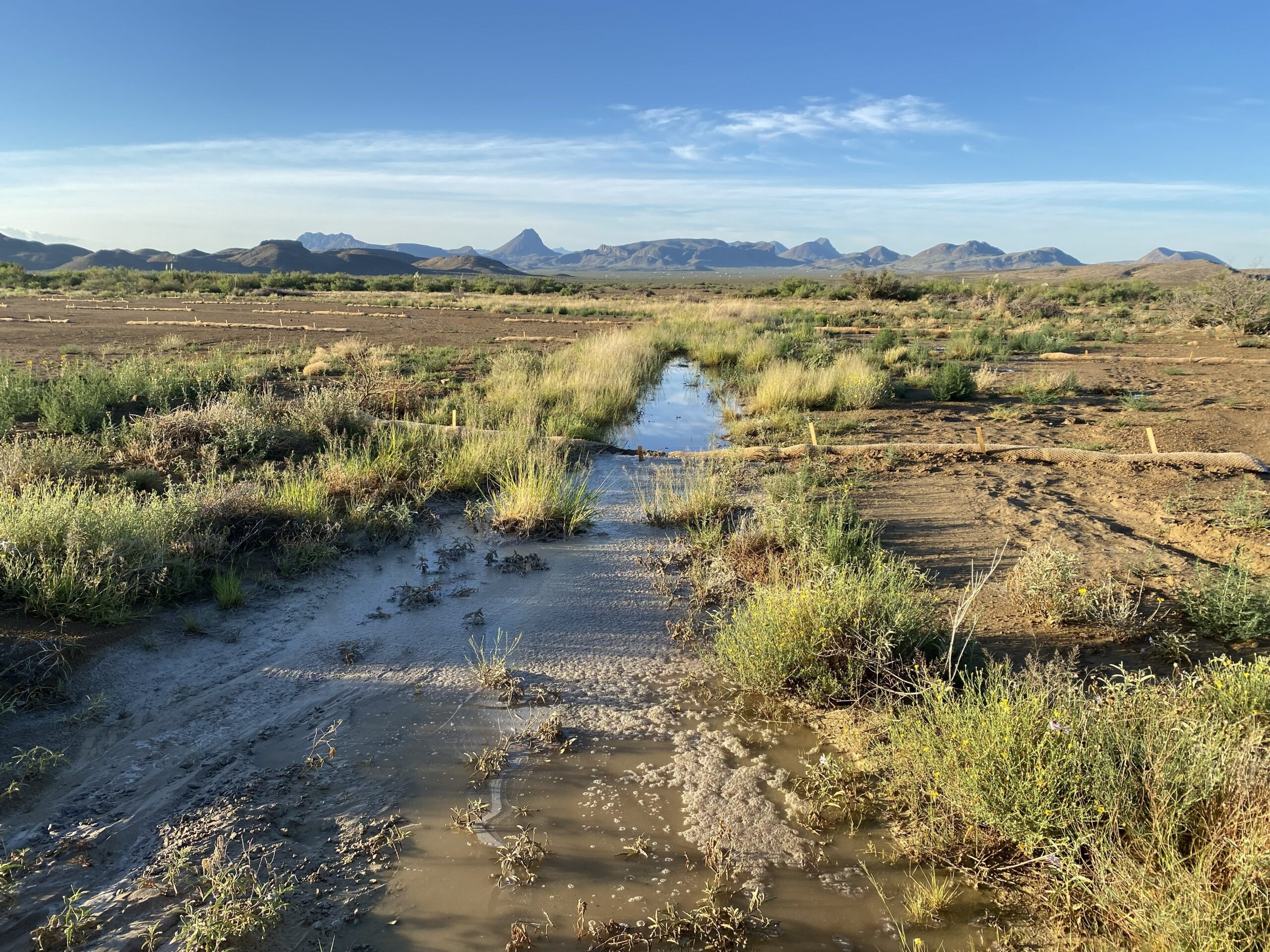
The Borderlands Research Institute at Sul Ross State University has received a $975,000 gift from John L. Nau III to advance the next phase of its habitat restoration work at Nine Point Mesa Ranch, building on his original $1 million investment that launched the project.
Nau, who owns the ranch in Brewster County, has been instrumental to the effort from the outset. He has supported the work through his philanthropy and by opening his gates to BRI researchers, establishing the ranch as a cornerstone of long-term, applied research in the Trans-Pecos.
The new gift supports Phase 2 of the multi-year research and restoration initiative. Over the past five years, Phase 1 focused on understanding what drives successful habitat restoration in arid landscapes. This research examined hydrology, soil erosion, native grass reseeding, brush management and invasive species. The work also included long-term monitoring of scaled quail populations using GPS satellite backpacks.
Now, BRI is moving from research to implementation. The team is ramping up proven restoration techniques across the landscape to restore habitat for scaled quail and other native wildlife.
“This investment allows us to move from discovery to deployment,” said Dr. Carlos Gonzalez, Nau endowed professor in Habitat Research and Management and associate director of research. “Over the past five years, we’ve built a deep understanding of what works in restoring Trans-Pecos landscapes. With Phase 2, we are applying those lessons at scale to rebuild habitat, strengthen ecosystem function and train the next generation of land stewards.”
Phase 2 will expand the use of techniques such as trincheras—small, loose rock dams that slow water movement—along with other erosion control structures, native seeding and targeted disturbance. Targeted disturbance is a restoration approach that focuses treatments where and when they will have the greatest impact—particularly in runoff zones and degraded soils—to slow water, increase infiltration and reduce erosion. Together, these strategies have been shown to improve water retention, reduce soil loss and support vegetation recovery in West Texas rangelands.
The Nine Point Mesa project serves as the foundation of BRI’s Habitat Restoration Program. It provides a living laboratory for applied research and hands-on student training.
“The work at Nine Point Mesa Ranch represents exactly the kind of science-based stewardship we need to sustain and improve working lands in Texas,” said Nau. “I’m proud to support BRI in taking what has been learned and putting it into action on the ground. My hope is that other ranch owners will be able to learn from this research and apply these targeted methods to their ranches.”
Located in the rugged landscapes of Far West Texas, Nine Point Mesa Ranch offers an ideal setting for studying restoration in arid and semi-arid systems. In these environments, water, soil and vegetation are closely connected, and small interventions can produce meaningful ecological gains.
By scaling these proven approaches, BRI researchers aim to improve habitat resilience, support wildlife populations and provide practical, science-based tools for landowners across the region.
Photo: Habitat restoration at Nine Points Mesa Ranch in Brewster County. (Caleb Hughes)